
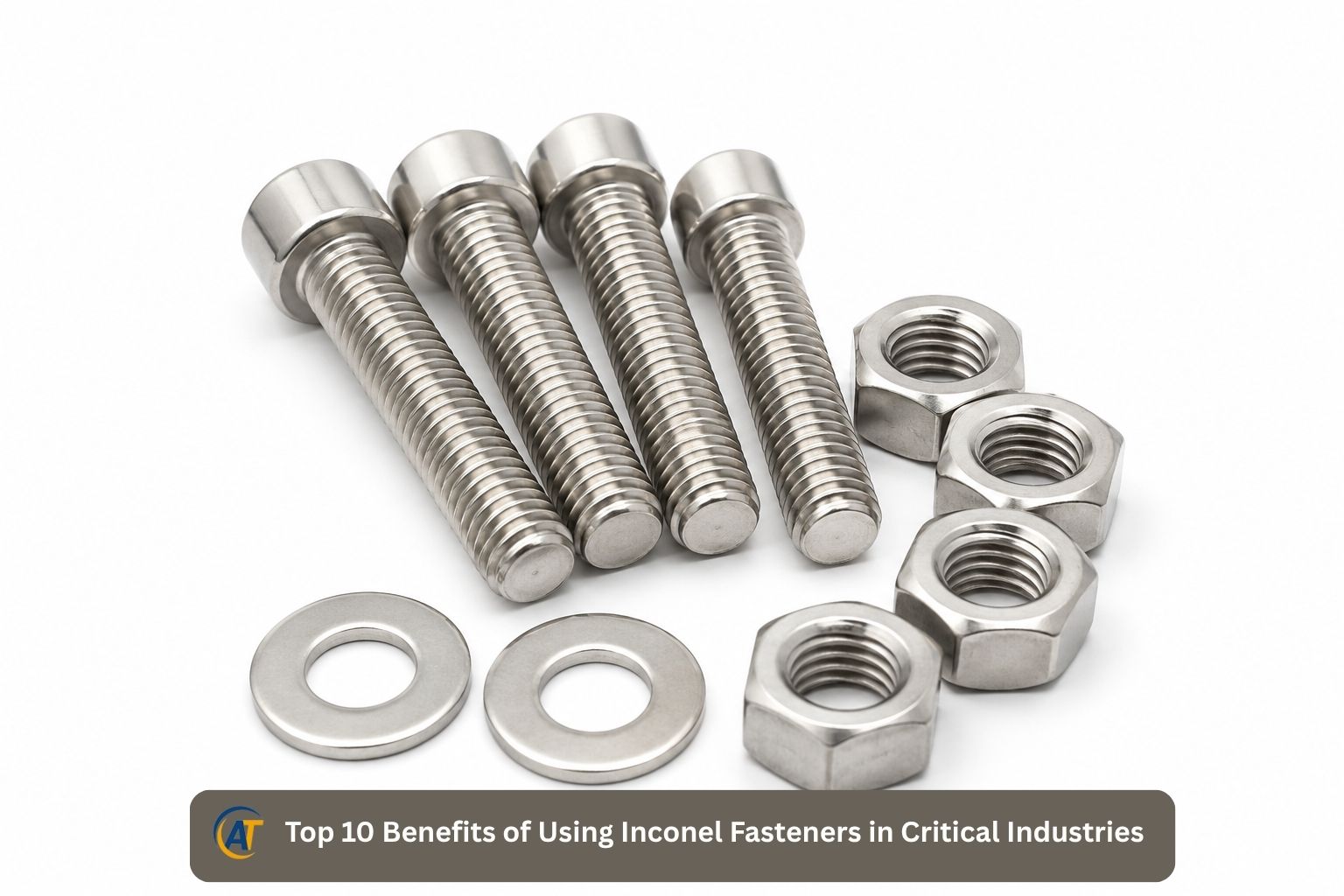
Fastening systems in aerospace, marine, oil and gas, chemical, and power generation plants deal with extreme heat, pressure cycling, and corrosive media that standard bolts cannot survive for long. A fastener that loosens or oxidizes under these loads puts the entire assembly at risk. Inconel fasteners are used across these sectors because they hold mechanical strength well beyond stainless steel. This article covers what these fasteners are, ten benefits behind their use, and the industries that rely on them.
What Are Inconel Fasteners?
Inconel is a family of corrosion-resistant nickel-chromium superalloys. Inconel fasteners, including hex bolts, stud bolts, nuts, and threaded rods, are used in demanding service conditions. They perform reliably under extreme heat and chemical exposure, where standard stainless fasteners can lose strength or corrode. Inconel alloy fasteners are chosen where even a single bolt failure could shut down a process line.
Top 10 Benefits of Using Inconel Fasteners
These ten points explain why engineers specify Inconel over standard fastener materials.
1. Excellent High Temperature Strength
Inconel maintains its tensile and yield strength at high temperatures, whereas carbon steel and stainless grades are softened. It is used in furnace linings, turbine casings, and boiler assemblies, and works well. Thermal cycling tends to lock joints in rather than loosen them over time.
2. Excellent Corrosion Resistance
Corrosion-Resistant Fasteners manufactured from Inconel can withstand acids, alkalis, and saltwater without pitting. Marine hardware and chemical processing lines depend on this property. A bolt that corrodes at the thread root fails quietly, often before visual signs appear.
3. Outstanding Oxidation Resistance
Prolonged heat exposure causes scaling on ordinary steel fasteners, and that scale eats into the load-bearing cross-section over time. Inconel forms a stable oxide layer that resists this breakdown, so the fastener keeps its dimensions after years in service.
4. High Mechanical Strength
Fasteners that will not stretch or shear are required for heavy loads and high-pressure joints. These loads can be handled by Inconel without the risk of thread stripping or bolt snapping, particularly when there is fluid pressure involved in flanged joints.
5. Long Service Life
Fasteners are subject to constant stress, which means they will fail after some period of time, and the cost of the replacement, as well as the downtime for the replacement, will be incurred. Inconel fasteners are able to resist more cycles before fatigue and thus will last for a greater number of cycles during the life of the equipment.
6. Reliable Performance in Harsh Environments
Offshore platforms, refineries, and power plants combine heat, moisture, and chemical exposure in ways few materials tolerate together. Inconel fasteners keep torque and seal integrity where a standard bolt would degrade within one maintenance cycle.
7. Low Maintenance Requirements
Corrosion and wear resistance reduce inspection, retorquing, and emergency replacement needs. Industrial Inconel fasteners also help minimize unplanned downtime caused by fastener failure. Maintenance teams spend less time inspecting and more time on their equipment.
8. Suitable for Cryogenic Applications
At extremely low temperatures, many metals turn brittle right when a joint needs strength most. Inconel keeps its toughness in cryogenic service. LNG terminals and gas processing plants use it in valves and connections exposed to liquefied gas temperatures.
9. Excellent Fatigue and Creep Resistance
Rotating equipment and pressure vessels apply repeated stress cycles over years, and creep under sustained load is a real failure mode at high temperature. Inconel resists both fatigue cracking and creep, which is why it shows up in turbine assemblies and pressure vessel connections.
10. Versatile Across Multiple Industries
Inconel Hex Bolts, Inconel Stud Bolts, and Inconel Threaded Rods meet fastening requirements ranging from structural connections to instrumentation mounts, and are available in sizes and grades suitable for both aerospace and refinery applications.
Industries That Commonly Use Inconel Fasteners
Several critical industries rely on Inconel fasteners where failure is not an option.
Aviation & Aerospace
Engine components and exhausts are subject to extreme temperatures and vibrations , as well as severe weight and strength restrictions . Fasteners must be able to take these conditions .
Oil and Gas
Fasteners can be simultaneously subjected to sour gas, high pressure, and saltwater at the same time in wellhead equipment and refining units.
Chemical Processing
Reactors and piping systems carry acids and alkalis that would corrode standard steel bolts within months.
Marine Engineering
Shipboard hardware or offshore structures are subject to continuous exposure to saltwater, and their corrosive resistance will determine their service life.
Power Generation
Boilers, turbines, and heat exchangers require fasteners that maintain torque through repeated thermal cycling.
Nuclear Facilities
Reactor components require materials that demonstrate long-term stability when exposed to radiation and heat.
Petrochemical Plants
Cracking units and distillation columns run hot with corrosive hydrocarbon streams.
Heat Treatment Equipment
Furnace fixtures and annealing line hardware need fasteners that survive direct, sustained heat.
Conclusion
Inconel fasteners hold their strength, resist corrosion and oxidation, and perform under conditions that push standard steel hardware past its limits. Aerospace, marine, oil and gas, chemical, and power generation projects specify them for this reason. Astectube supplies Inconel fasteners for these demanding applications. Reach out to discuss specifications for your project.