
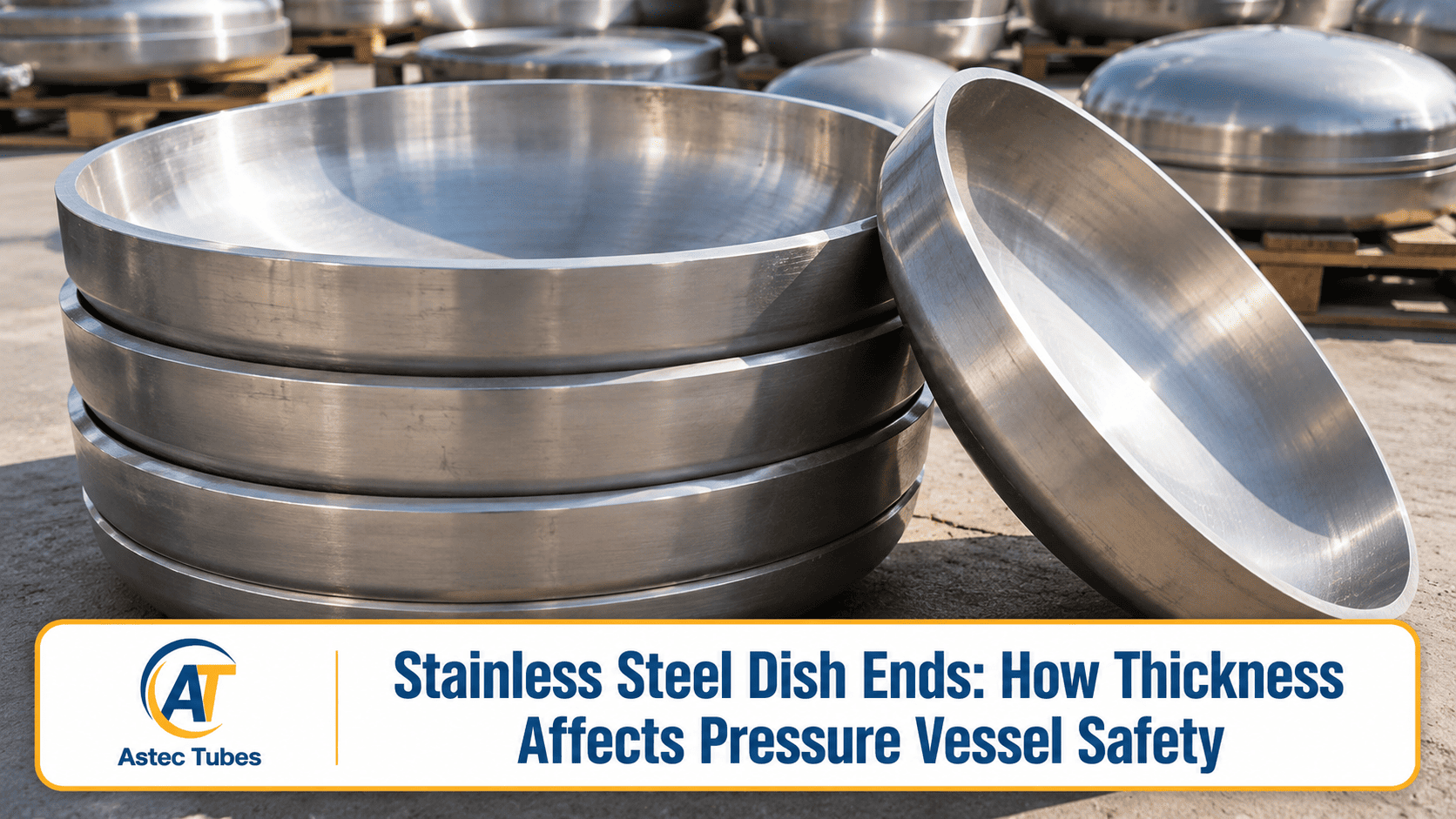
A dish end that is a few millimetres too thin can turn a routine pressure cycle into a rupture. Stainless steel dish ends close off vessels, tanks, and industrial equipment, and they carry the full internal pressure every time the system runs. Picking the right thickness decides whether that head holds its shape under operating loads or slowly thins and fails over years of corrosion. Design pressure, vessel diameter, material grade, and head geometry all pull the thickness number in different directions. Get the balance wrong and the whole vessel inherits the weakness. A stainless steel dish end has to be matched to its service.
What Are Stainless Steel Dish Ends?
Dish ends are formed metal components that seal the open end of a vessel and spread pressure loads across a curved surface instead of a flat one. The curve does the work. Three shapes dominate industrial use: hemispherical heads with a half-sphere profile, ellipsoidal heads with a flatter elliptical curve, and torispherical heads built from a crown radius joined to a tighter knuckle. Fabricators select the stainless grade to match the job, weighing corrosion resistance, service temperature, and the mechanical strength the vessel demands. You find these heads closing reactors in chemical processing, jacketed vessels in pharmaceutical plants, storage and mixing tanks in food processing, and bulk holding tanks across general industrial storage.
Why Does Dish End Thickness Matter for Pressure Vessel Safety?
Thickness governs how a head behaves under load, and each aspect affects safety differently.
- Pressure resistance: Adequate wall thickness lets the head carry its design pressure without yielding or bulging during normal operation.
- Load distribution: The combination of head geometry and thickness controls how stress spreads across the curve.
- Corrosion allowance: Extra material gets added where the process fluid is expected to corrode or erode the surface over the vessel’s life.
- Fabrication effects: Forming stretches the metal and thins it, with certain regions of the finished head losing more wall than others.
- Service life: Correct grade and thickness together keep the head structurally sound through years of pressure cycling and thermal change.
Thickness on its own does not make a vessel safe. Geometry, material properties, weld quality, design conditions, and inspection all share the load, and a thick head with a bad weld is still a liability.
Key Factors That Determine Stainless Steel Dish End Thickness
Several engineering inputs feed into the final thickness figure, and skipping any one of them skews the result.
- Design pressure: Higher operating pressure usually pushes thickness up, though how much depends on the head’s shape and the grade in use.
- Vessel diameter: Larger head dimensions raise the required thickness because the curved surface spans a wider load.
- Material grade: Allowable load is a function of temperature and the grade of stainless, so it can be that a stronger alloy can mean a thinner wall sometimes.
- Head shape: Hemispherical, ellipsoidal, and torispherical profiles each follow their own design rules and thickness demands.
- Operating temperature: Rising temperature cuts material strength and lowers the allowable design stress the head can rely on.
- Corrosion allowance: Added thickness gets specified around the expected material loss in the actual process environment.
- Forming and manufacturing tolerances: The starting plate thickness must account for thinning during forming and the permitted material tolerance band.
How Different Dish End Shapes Affect Thickness Requirements
Each head profile handles pressure in its own way, and the table below sets out how shape shifts the thickness conversation.
| Dish End Type | Shape Characteristics | Thickness Considerations |
| Hemispherical | Half-sphere profile | Generally efficient for pressure loading but requires greater forming depth |
| Ellipsoidal | Elliptical profile | Thickness depends on the head proportions and applicable design rules |
| Torispherical | Crown with a rounded knuckle and outer flange | Local geometry, particularly the knuckle region, influences design requirements |
The final dimensions have to be calculated against the applicable design code, with the vessel’s real operating conditions driving the numbers.
Manufacturing, Inspection, and Quality Checks
Good manufacturing practice is what proves a finished head actually meets its specification. Operators measure wall thickness before forming and again afterward, since the forming step changes it. They check the dimensions, the profile curve, and the surface condition against the drawing. Welds get inspected wherever the head is fabricated from sections or joined to the shell. Material certificates and grade traceability are verified so the alloy in the head matches what the design assumed. The required non-destructive examinations and pressure tests then run according to the vessel design and the governing code. The number that matters most is the minimum thickness after forming, because that is the wall the vessel lives with.
How to Select the Right Stainless Steel Dish End
Confirm these points with Astec Tubes before you commit to a head:
- Design pressure and operating temperature for the vessel.
- Vessel diameter and the head geometry you need.
- Stainless steel grade and the corrosion conditions it will face.
- Required thickness after forming, plus any corrosion allowance.
- Applicable pressure vessel code, such as ASME Section VIII, where it governs the build.
Lean on qualified pressure vessel design calculations
Conclusion
Correct dish end thickness is what lets a vessel contain its pressure and hold its integrity for the long haul. That outcome rests on sound engineering calculations, the right material, disciplined manufacturing controls, and thorough inspection working together. Thickness is one input among several, and treating it as the whole answer invites trouble down the line. Explore Astec Tubes’ stainless steel dish end product page to match the right head to your vessel.