
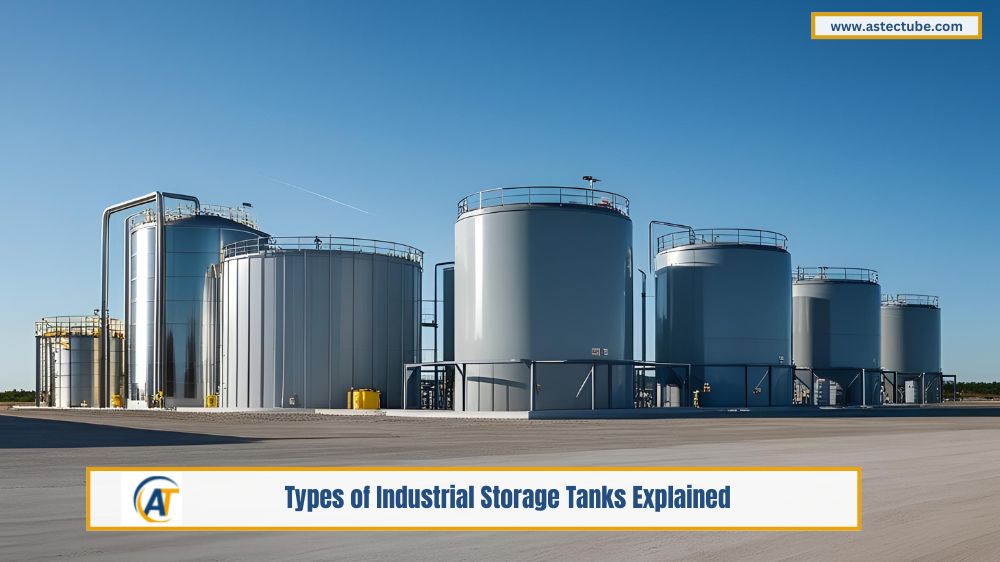
In the industrial world, storage tanks play a vital role in storing liquids, gases, and even solids in bulk quantities. These tanks are used across industries like oil and gas, chemical manufacturing, food processing, agriculture, and water treatment. Understanding the different types of industrial storage tanks is essential for selecting the right system based on the nature of the stored material, environmental conditions, and safety requirements. In this blog, we explore the various types of industrial storage tanks, their features, and their typical applications.
Overview of Common Storage Tank Materials
The material of a storage tank affects how it performs in different environments. It must resist corrosion, handle high or low temperatures, and support the weight of the stored material. Common materials used in storage tanks include carbon steel, stainless steel (304 and 316), duplex and super duplex stainless steel, nickel alloys like Inconel, Monel, and Hastelloy, titanium, composites like FRP and HDPE, and concrete. Each has its strengths and ideal use cases.
Types of Industrial Storage Tanks Explained
Carbon Steel Storage Tanks
Carbon steel is a strong and affordable material. It’s made mostly from iron and carbon. These tanks are known for their mechanical strength and low cost. However, carbon steel rusts easily when exposed to air and moisture. To prevent this, tanks are coated or lined. Carbon steel tanks are common in oil and gas, water storage, and industrial manufacturing, where corrosion is not a big concern or where coatings are used.
Stainless Steel Storage Tanks
Stainless steel tanks are known for their resistance to rust and staining. Grades 304 and 316 are the most used. Grade 304 has good corrosion resistance, while 316 has added molybdenum for better protection in salty or chemical-heavy settings. These tanks are popular in food processing, pharmaceutical, and chemical industries. They are easy to clean and maintain but cost more than carbon steel. Fabrication is smooth, and they last long with regular checks.
Duplex and Super Duplex Stainless Steel Tanks
duplex storage tanks and super duplex storage tanks have a mix of ferrite and austenite structures. This gives them better strength and corrosion resistance especially in harsh settings with chlorides. These tanks work well where both toughness and corrosion resistance are needed. They are used in offshore platforms, chemical plants, and desalination plants. Compared to regular stainless steel, they perform better in tough conditions but are also more expensive.
Nickel Alloy Tanks: Inconel, Monel, and Hastelloy
Nickel alloy tanks are made for extreme environments. Inconel handles high heat. Monel is great for saltwater. Hastelloy works well with strong acids. These tanks offer high resistance to corrosion and heat. They’re used in marine settings, power plants, and chemical processing. While expensive, they last longer in extreme conditions. They’re chosen when regular metals won’t last or where safety is critical.
Titanium Storage Tanks
Titanium strong strong, light, and resists corrosion better than most metals. It’s not affected by saltwater or many chemicals. Because it costs more, titanium is used only when its unique properties are needed. These tanks are seen in aerospace, medical, and desalination industries. Even with the high cost, the long life and low maintenance make it a smart choice for the right application.
Composite and Plastic Storage Tanks
Composites, such as FRP (fiberglass-reinforced plastic), and plastics, such as HDPE, are materials of choice for tanks that must be lightweight and resistant to rust—they resist corrosion from acids, alkalis, and other reactive materials. They are generally found in water treatment, chemical storage, and farming. They’re easy to move and install. But they can crack or weaken under high pressure or heat. Regular checks help keep them safe.
Concrete Storage Tanks
Concrete tanks are built for long-term, large-volume storage. They are strong and stable and are used to store water, wastewater, or fire protection supplies. For chemicals, a special lining or coating is added inside. While they last for decades, they’re hard to move or modify once built. Still, for large-scale storage, they’re often the most cost-effective option.
Types of Storage Tank Designs and Constructions
- Vertical Cylindrical Tanks are the most common as they take up less space and are used for storing liquids.
- Horizontal Cylindrical Tanks are used where height is limited and are common in transport and underground settings.
- Fixed Roof Tanks have a non-moving roof. They’re used to store liquids with low vapor pressure.
- Floating Roof Tanks have a roof that moves with the liquid level and reduces vapor loss in oil and fuel storage.
- Open Top Tanks are simple in design and used where vapor or odor isn’t a concern.
Pressurized and Cryogenic Tanks are built for extreme pressure or very cold materials like liquid gases.
Storage Solutions for Bulk Solid Materials
Storing solids is different from storing liquids. Powders, pellets, and grains need tanks that allow easy flow. Materials like steel, aluminum, or plastic are used depending on the product. Designs often include slopes, cones, or vibration systems to prevent clogging. These tanks are used in food, cement, and plastic manufacturing.
Critical Factors in Selecting the Right Storage Tank
The tank material must match the material being stored. Heat, pressure, and outside exposure all affect tank life. Industry standards like API, ASME, and ISO help ensure safety. Ongoing maintenance also plays a role. Costs can be reduced by choosing the right tank early on and keeping it in good shape.
Conclusion
Selecting the right type of industrial storage tank is crucial for operational efficiency, safety, and regulatory compliance. Factors such as the nature of the material, storage conditions, volume requirements, and environmental considerations should guide the decision-making process.
Whether it’s storing harsh chemicals or food-grade liquids, understanding the different tank types ensures you invest in the most appropriate solution for your industry needs.