
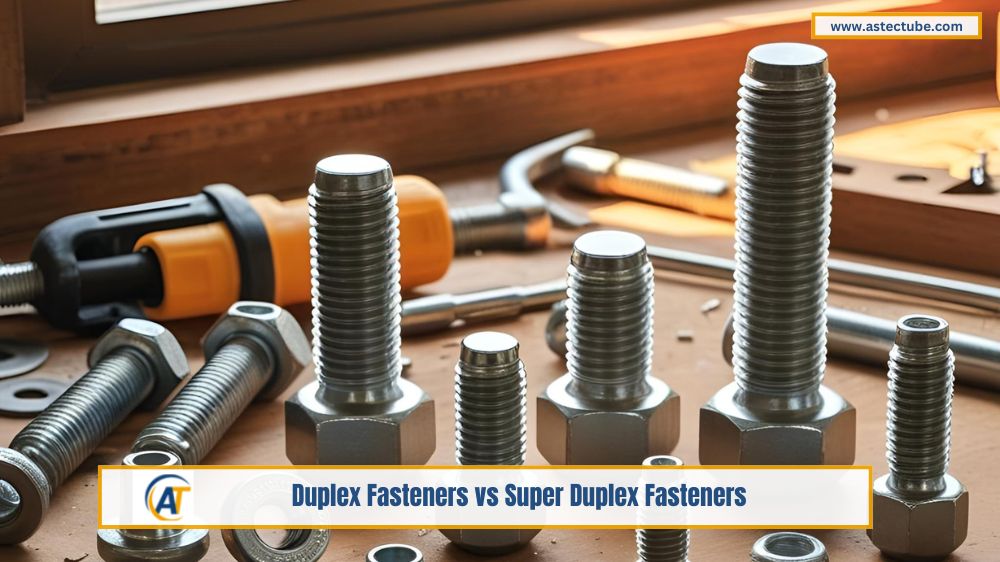
Stainless steel fasteners are used in structures and machines where strength and rust resistance are important. These fasteners hold parts together in harsh settings, from factories to offshore rigs. Among the various types of stainless steel, duplex and super duplex are the preferred choices in tough environments. Their strong build and resistance to damage make them ideal for high-stress use. In this blog, you’ll learn the key differences between duplex steel fasteners and super duplex fasteners, their benefits, and how to choose the right one.
Overview of Duplex and Super Duplex Stainless Steel
Duplex stainless steel is a blend of two steel types—austenitic and ferritic. This mix gives it good strength and moderate corrosion resistance. It works well in places where both toughness and rust protection are needed.
Super duplex stainless steel is a stronger version. It has more chromium, molybdenum, and nitrogen. These extra elements give it better corrosion resistance and higher strength than standard duplex.
Both materials are known for lasting long and needing little maintenance. But super duplex performs better in highly corrosive or high-pressure settings.
Types of Fasteners Made from Duplex and Super Duplex Steel
You’ll find common fasteners like bolts, nuts, screws, and studs made from both duplex and super duplex steel.
- Bolts are used in machines, marine structures, and heavy-duty equipment.
- Nuts pair with bolts for secure fastening in chemical and offshore systems.
- Screws are used in pumps, valves and smaller mechanical parts.
- Studs are used in flanged joints, reactors, and pressure vessels.
These fasteners are used in shipbuilding, oil rigs, desalination plants, chemical plants, and more.
Mechanical Properties Comparison
Duplex fasteners have good strength and are known for their yield strength which is about twice that of regular stainless steel. Super duplex fasteners are even stronger. They can handle higher loads without bending or breaking.
In terms of hardness, super duplex performs better, making it more wear-resistant.
For impact resistance, both are good, but super duplex stands up better to sudden shocks.
When it comes to fatigue resistance, super duplex again has an edge due to its stronger build.
Corrosion Resistance Comparison
Duplex steel resists pitting and crevice corrosion, especially in chloride-rich environments. Super duplex performs better in these conditions due to its higher alloy content.
In terms of stress corrosion cracking, duplex fasteners hold up well, but super duplex handles more aggressive environments like deep-sea rigs and chemical tanks.
In harsh environments—like saltwater, acidic solutions or high temperatures—super duplex fasteners last longer and offer better safety.
Cost Considerations
Duplex fasteners are more affordable than super duplex. They give good strength and corrosion resistance for a lower price. Super duplex fasteners cost more due to their complex alloy makeup.
But if your application involves strong chemicals or deep-sea pressure, the extra cost is worth it. Super duplex lasts longer and needs less maintenance, which lowers total cost over time.
Applications: When to Use Duplex vs Super Duplex Fasteners
Offshore Oil and Gas Platforms
Super duplex fasteners are often used in offshore rigs and pipelines. They resist saltwater corrosion and handle high pressure well.
Chemical Processing Plants
Duplex fasteners are suitable for tanks, pumps, and pipe systems. They offer good resistance to chemicals and high temperatures.
Desalination Plants
Super duplex fasteners work better here. They stand up to chloride-rich environments and reduce the risk of corrosion.
Marine Equipment and Shipbuilding
Duplex fasteners are used in ship parts and marine hardware. They offer a good mix of strength and corrosion resistance.
Pulp and Paper Mills
Duplex fasteners are used in machinery and storage tanks. They perform well in environments with moisture and chemical exposure.
Power Plants and Heat Exchangers
Super duplex fasteners are ideal for boilers and heat exchangers. They hold up under thermal stress and chemical attack.
Pharmaceutical and Food Processing
Duplex fasteners are often used where hygiene and corrosion resistance matter. They are safe for clean environments and easy to maintain.
Water Treatment Plants
Super duplex fasteners are used in filtration systems and pipework. They last longer in harsh water conditions.
Use duplex fasteners when the environment is moderately corrosive and the cost is a concern. Choose super duplex for more demanding conditions where longer life and higher performance are needed.
Manufacturing Standards and Certifications
Duplex and super duplex fasteners comply with standards like ASTM A182, A479, and ISO 15156, ensuring strength, corrosion resistance, and dimensional accuracy.
Certifications are essential for quality assurance, providing traceability, verifying compliance, and ensuring reliability in demanding applications such as offshore, marine, and chemical processing industries.
Installation and Maintenance Tips
To avoid galling, use proper lubricants during installation. Do not over-tighten. Use tools with the right torque settings.
For maintenance, check for surface damage, rust, or wear. Clean the fasteners during routine checks. Replace worn parts to avoid sudden failure.
Conclusion
Duplex and super duplex fasteners both provide superior strength and corrosion resistance, with super duplex offering higher performance in more aggressive and demanding environments. The key difference lies in their alloy composition, which affects durability and cost. Selecting the right fastener depends on project requirements such as environmental conditions, pressure, and temperature. For optimal performance and safety, it’s essential to consult with industry experts who can recommend the most suitable material based on specific application needs and technical requirements.